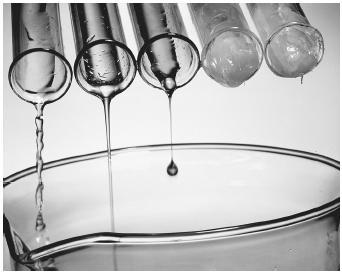
What is viscosity?
This question is often best answered by example. Imagine a styrofoam cup with a hole in the bottom. If I then pour honey into the cup I will find that the cup drains very slowly. That is because honey's viscosity is large compared to other liquids' viscosities. If I fill the same cup with water, for example, the cup will drain much more quickly.*
Viscosity is the rate at which a substance flows.
The rate at which a substance flows depends on the bond between the molecules inside of them. For example, the bond between the molecules in water is weak, which allows it to move and flow quickly. But the bond between the molecules in honey or molasses is much stinger, causing it to flow slowly.
Heat can also affect the rate at which substances flow because viscosity decreases when it's heated, and when it's decreased, the fluid flows faster. This is because the particles inside a fluid gain energy when they are heated. When they gain energy, they move faster. More energy equals more movement. Because molasses is a very viscous substance, when it is poured cold, it will flow slowly. But if you pour it after you heat it up, it will flow faster.
vis·cous (vĭs′kəs)